

Reciprocating compressors, also known as piston compressors, are among the most widely used types of compressors in air conditioning, refrigeration, and industrial gas compression systems. These compressors operate on the principle of positive displacement, using a piston-cylinder mechanism to compress refrigerant vapor.
They are especially valued for their reliability, versatility, and suitability for high-pressure applications.
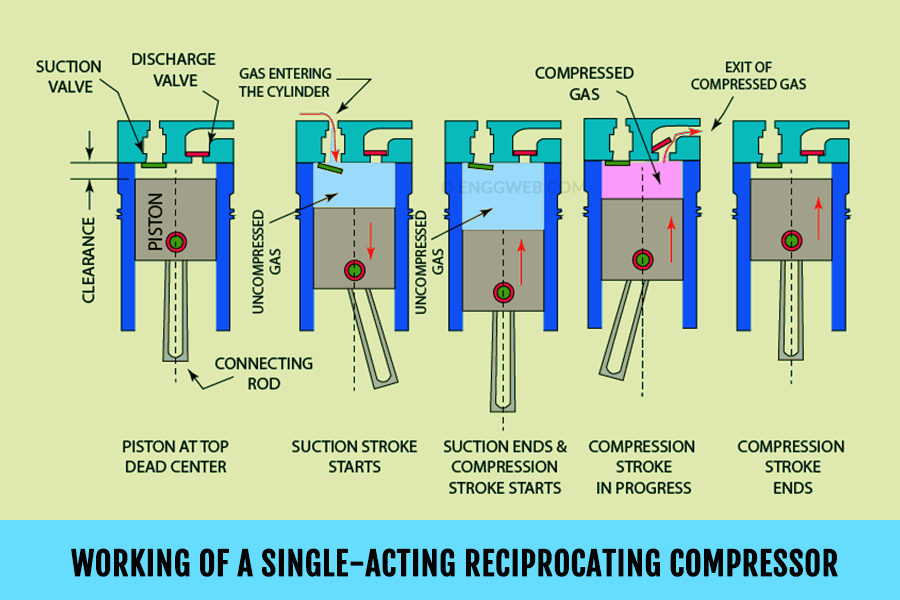
How Reciprocating Compressors Work
A reciprocating compressor operates similarly to an internal combustion engine:
- A piston moves up and down inside a cylinder.
- On the suction stroke, the piston moves down, drawing low-pressure refrigerant vapor into the cylinder through the suction valve.
- On the compression stroke, the piston moves up, compressing the vapor and forcing it out through the discharge valve to the condenser.
This back-and-forth (reciprocating) action results in intermittent compression and discharge of refrigerant.

Key Features & Advantages
- Robust Design
Proven mechanical reliability, suitable for harsh and high-pressure environments. - Wide Range of Capacities
Available from small fractional-horsepower units to large industrial models. - Serviceability
Easy to maintain and repair, with widely available spare parts. - Multiple Cylinder Configurations
Can be configured with 1 to 12 cylinders to match capacity needs. - Oil-Lubricated or Hermetic Options
Available as open, semi-hermetic, and fully hermetic compressors.
Applications
- Domestic Refrigeration: Small hermetic compressors in fridges and freezers.
- Commercial Refrigeration: Walk-in coolers, display cases, food storage.
- Industrial Cooling: Cold storage warehouses, chemical plants.
- Air Conditioning: Small to medium-sized commercial AC systems.
- Transport Refrigeration: Trucks, trailers, marine systems.